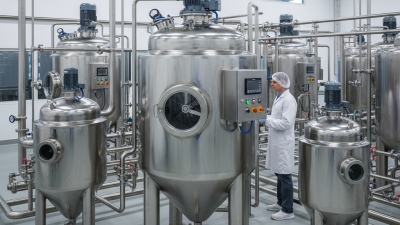
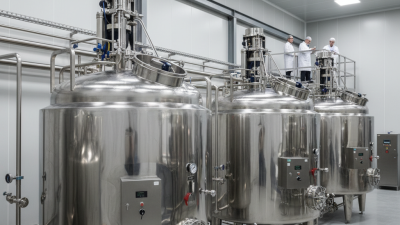
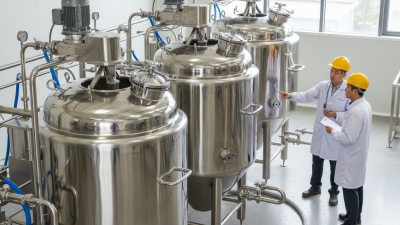
Choosing the right Stainless Steel Mixing Tanks in 2026 requires more than comparing prices, capacities, and polished surfaces. A tank may look excellent in a product photograph, yet perform poorly with thick syrup, abrasive powder, or temperature-sensitive liquids. The practical choice begins with the process. Consider batch size, viscosity, mixing time, operating temperature, cleaning method, and production frequency. Small details matter.
Start with the material grade. Stainless steel 316L often suits corrosive or hygienic applications, while 304 may be adequate for less demanding products. Confirm the internal finish, weld quality, gasket materials, and surface roughness. A rough weld can trap residue. That creates cleaning problems. Ask suppliers for material certificates, pressure ratings, inspection records, and documented testing. Reliable manufacturers should explain these details clearly, not hide behind attractive specifications.
The agitator deserves equal attention. An anchor impeller may handle heavy creams, while a pitched-blade turbine can provide stronger circulation for thinner liquids. Incorrect speed can create foam, heat, or uneven batches. It happens more often than expected. In 2026, buyers should also review automation, load cells, temperature sensors, variable-speed drives, and clean-in-place capability. These features can reduce labor, but they also add maintenance needs and initial cost. A perfect tank does not exist. The best selection balances product behavior, hygiene, energy use, future capacity, and budget. Speak with engineers who understand your actual process. A catalog cannot replace a trial batch.
How to Choose Stainless Steel Mixing Tanks in 2026?
Tank selection begins with the process, not the catalog. Batch tanks suit variable recipes and controlled production runs. Inline mixers support continuous flow and shorter residence times. High-shear mixers disperse powders, emulsify liquids, and reduce visible lumps. Anchor agitators handle viscous creams, while propellers suit low-viscosity liquids. That choice matters.
Application requirements narrow the stainless steel grade. Grade 304 often serves food, beverage, and general chemical duties. Grade 316L offers stronger resistance to chlorides, acids, and repeated cleaning cycles. A jacketed vessel supports heating or cooling, while an insulated shell protects temperature-sensitive formulas. Pharmaceutical service may also require hygienic welds, drainability, and documented surface finishes. The details become expensive later.
Grand View Research estimated the global industrial mixers market at about USD 2.7 billion in 2023, with continued growth expected through 2030. This expansion reflects demand across food, pharmaceuticals, personal care, and specialty chemicals. MarketsandMarkets also identifies high-shear and inline systems as important growth areas because manufacturers seek faster dispersion and consistent quality. Still, market growth does not guarantee a suitable tank.
In practical plant reviews, a polished tank can still mix poorly. Impeller diameter, clearance, baffles, viscosity, and batch volume must match. Ask for mixing trials, power calculations, and cleanability evidence. Do not select capacity alone. Sometimes, smaller working volume performs better. This is easy to overlook.
How to Choose Stainless Steel Mixing Tanks in 2026?
Choosing a stainless steel mixing tank in 2026 starts with defining the process, not browsing equipment catalogs. State working capacity, batch size, liquid viscosity, temperature, and mixing time. Leave headspace for foam, expansion, and safe circulation. A tank filled to the rim is rarely a good tank. In practice, operators often specify volume too tightly. That mistake can cause unstable blending and difficult cleaning. Record the smallest and largest batch, not only the average. Also identify whether powders, crystals, or fragile particles enter the vessel.
Material grade must match chemistry and cleaning conditions. Common stainless options differ in corrosion resistance, weld performance, and cost. Confirm chloride exposure, acidity, alkalinity, and operating temperature with a qualified materials engineer. Surface finish matters where residue can collect. Smooth, accessible welds support inspection and sanitation. Ask for material certificates, weld procedures, and pressure or leak test records. These documents do not replace inspection. They make verification practical. Consider impeller geometry separately. A durable tank can still mix poorly with the wrong blade.
Tips: Draw the process on paper before requesting quotations. Mark every inlet, outlet, sensor, spray device, and access point. Check whether the agitator reaches the lowest working level. Test a difficult batch using representative viscosity and solids. Small trials reveal dead zones that calculations may miss. Revisit the design after operator feedback. Real production is often less tidy than the original specification. Choose controls that clearly show temperature, speed, and alarm status. Avoid maximum motor power without checking shear, heat, and energy use.
| Selection Dimension | Typical Requirement | Recommended Specification | Suitable Stainless Steel Grade | Process Considerations | Practical Decision Rule |
|---|---|---|---|---|---|
| Working Capacity | Small-batch production: 50–500 L | Design working volume at approximately 60–80% of the total tank volume. | 304L for general non-corrosive products; 316L for chloride-containing or hygienic products. | Allow space for liquid expansion, vortex formation, foam, and safe agitator operation. | Select a 100–800 L nominal tank when the required working volume is 50–500 L. |
| Working Capacity | Medium production: 500–5,000 L | Use a nominal volume about 20–35% greater than the maximum batch volume. | 304L for general processing; 316L where corrosion resistance and cleanability are priorities. | Check whether the tank can maintain adequate agitator immersion at the minimum batch level. | Choose capacity from the actual minimum and maximum batch range, not only the average batch size. |
| Working Capacity | Large production: 5,000–50,000 L or more | Confirm foundation loading, transport limits, access height, and installation method before final sizing. | 316L is commonly selected for hygienic, pharmaceutical, food, and chemically demanding service. | Large tanks may require multiple impellers, external recirculation, load cells, and dedicated utility connections. | Complete structural, utility, and site checks before approving the tank diameter and height. |
| Material Grade | General aqueous products, mild chemicals, and non-chloride service | 304L stainless steel, with low carbon content for improved weld corrosion resistance. | 304L | Suitable for many water-based products, dry ingredients, and mildly corrosive formulations; not ideal for significant chloride exposure. | Use 304L when product chemistry and cleaning agents do not create a chloride or high-corrosion risk. |
| Material Grade | Chloride-containing products, saline solutions, pharmaceutical, food, and personal-care processing | 316L stainless steel, which contains molybdenum for improved resistance to localized corrosion compared with 304L. | 316L | Confirm chloride concentration, temperature, pH, cleaning chemicals, and exposure time; 316L is not immune to chloride stress corrosion. | Prefer 316L for hygienic service or when chloride exposure makes 304L unsuitable. |
| Material Grade | Highly corrosive chloride environments or higher mechanical-strength requirements | Duplex 2205 may be considered after a detailed corrosion and fabrication review. | 2205 duplex stainless steel | Offers higher strength and improved chloride resistance than common austenitic grades, but welding, forming, and finishing require specialist control. | Use only after corrosion testing and confirmation that fabrication and hygienic requirements can be met. |
| Material Grade | Severe corrosive service involving strong acids or high-temperature chloride conditions | High-alloy stainless grades may be evaluated as an alternative to standard 304L or 316L. | 904L or another corrosion-resistant alloy selected by an engineer | Material selection must be based on concentration, temperature, impurities, cleaning cycles, and corrosion data. | Do not choose a high-alloy grade solely by name; obtain a documented compatibility assessment. |
| Operating Pressure | Atmospheric mixing with vented operation | Atmospheric tank with a sanitary vent, overflow protection, and suitable access cover. | 304L or 316L, depending on product chemistry | Provide adequate vent capacity to prevent vacuum or overpressure during filling, draining, heating, or cooling. | Use an atmospheric design only when the process does not require pressure or vacuum operation. |
| Operating Pressure | Vacuum processing, vacuum transfer, or closed-system mixing | Specify a vacuum-rated vessel with reinforced shell, tested fittings, and a controlled vacuum relief system. | 316L is commonly selected for hygienic and chemically demanding vacuum service. | A standard atmospheric tank may collapse under vacuum; vessel design pressure and vacuum rating must be documented. | Never apply vacuum to a tank unless the complete vessel and all connected components are rated for it. |
| Agitation | Low-viscosity liquids and simple blending | Axial-flow impeller, typically operated at moderate speed to promote top-to-bottom circulation. | 304L or 316L wetted parts | Impeller diameter, speed, liquid height, baffles, and viscosity determine blend time and power demand. | Specify viscosity, density, solids content, batch volume, and target blend time before selecting the mixer. |
| Agitation | High-viscosity products, pastes, or shear-sensitive materials | Low-speed anchor, gate, helical, or specialized agitator with a close wall clearance. | 316L for hygienic or corrosive service; grade should match the product and cleaning regime. | Consider torque, heat generation, wall-scraping requirements, seal design, and possible variable-frequency control. | Size the drive by required torque at maximum viscosity, not by motor power alone. |
| Heating and Cooling | Temperature-controlled mixing | Dimple jacket, half-pipe coil, conventional jacket, or internal coil selected according to heat duty. | Match the jacket and coil material to the tank grade and utility chemistry. | Calculate heat-transfer area from batch volume, target temperature, heating or cooling rate, and utility temperature. | Confirm both process heat duty and allowable wall temperature to prevent product degradation. |
| Hygienic Design | Food, beverage, pharmaceutical, cosmetic, or personal-care processing | 316L wetted surfaces, continuous sanitary welds, drainable geometry, and hygienic fittings. | 316L is generally preferred for product-contact surfaces. | Internal surfaces are often specified at Ra ≤ 0.8 µm for hygienic service; stricter finishes may be required by the process. | Define surface finish, weld treatment, dead-leg limits, cleaning method, and inspection documentation in the specification. |
| Cleaning Method | Manual cleaning or limited batch changeover | Access manway, drainable bottom, removable fittings, and surfaces that can be visually inspected. | 304L or 316L, based on chemical compatibility | Manual cleaning requires safe access, suitable drainage, and a documented cleaning procedure. | Prioritize accessibility and complete drainage when automated cleaning is not available. |
| Cleaning Method | Clean-in-place (CIP) operation | Fixed spray device, sanitary piping, self-draining design, and validated flow and coverage. | 316L is commonly used for hygienic product-contact systems. | Cleaning effectiveness depends on flow velocity, temperature, chemical concentration, contact time, spray coverage, and drainage. | Specify the complete CIP circuit, not only the spray ball or spray device. |
| Bottom Configuration | Fast drainage and minimal product retention | Sloped or dished bottom with a low-point outlet sized for the product viscosity and drain rate. | Use the same or compatible grade as the product-contact shell. | Flat bottoms can retain liquid; outlet location, valve geometry, and agitator clearance affect drainability. | Choose the bottom shape according to viscosity, solids content, cleaning method, and required drain time. |
| Instrumentation | Basic batch monitoring | Temperature sensor, level indication, sampling valve, and pressure or vacuum indication where applicable. | Wetted sensor materials should be compatible with the selected tank grade and process fluid. | Sensor placement should avoid dead zones, impeller interference, and false readings caused by foam or vortexing. | Specify measurement range, accuracy, hygienic connection, and calibration requirements. |
| Final Specification | Before purchase or fabrication | Document capacity, material grade, design pressure, operating temperature, agitator duty, surface finish, utilities, and cleaning method. | Final grade must be confirmed against the complete chemical and thermal profile. | Include drawings, weld standards, inspection records, pressure or vacuum tests, surface-finish records, and material certificates where required. | Approve the tank only after capacity, chemistry, mechanical design, hygiene, and maintenance requirements are jointly reviewed. |
Choosing a stainless steel mixing tank in 2026 requires more than checking volume and steel grade. Agitation, heat transfer, cooling, and automation must work as one system. A 1,000-liter tank with a low-speed anchor behaves very differently from one using a high-shear rotor-stator. Test viscosity, solids content, batch temperature, and cleaning time before approving the design. Small impeller changes can affect product uniformity and energy demand.
Heating and cooling deserve equal attention. Ask for heat-transfer calculations, not only a quoted jacket size. A vessel processing viscous syrup may need a dimple jacket, internal coil, or both. The International Energy Agency reports that industrial process heat remains a major source of global energy demand, so inefficient heating can become a long-term operating penalty. Insulation, temperature sensors, and staged heating can reduce overshoot. However, calculations often assume ideal fluid movement. Actual batches are less cooperative.
Automation should provide useful control, not decorative screens. Deloitte’s 2024 Smart Manufacturing and Operations Survey found that 92% of manufacturers view smart manufacturing as important for competitiveness. Consider recipe control, variable-speed drives, alarm history, load-cell measurement, and data export. A practical setup records temperature and torque every batch. It also allows manual intervention when sensors drift. That matters. Automation can hide a weak mixing profile if nobody reviews the data. I would challenge any proposal promising perfect consistency without pilot trials, cleaning validation, and operator feedback. A polished specification is still only a starting point.
How to Choose Stainless Steel Mixing Tanks in 2026?
Sanitary design should guide the purchase, not only tank capacity. Choose 316L stainless steel for product-contact areas when corrosion risk justifies it. A smooth finish, often specified at Ra ≤0.8 μm, helps reduce residue retention. Inspect welds, gaskets, agitator shafts, and outlet valves closely. Dead legs are small, but they can shelter contamination. EHEDG hygienic design guidance emphasizes cleanability, drainability, and accessible product-contact surfaces. FDA Food Code 2022 also requires food-contact equipment to be corrosion-resistant, smooth, and easily cleanable. These requirements sound simple. They are not always easy to verify from drawings.
Safety needs equal attention. Specify guards around rotating equipment, emergency stops, shaft interlocks, grounding, and pressure or vacuum protection. Check whether the tank remains stable during high-speed mixing and partial loads. The U.S. Bureau of Labor Statistics recorded 5,283 fatal occupational injuries in 2023, according to its Census of Fatal Occupational Injuries. A mixing tank is not automatically safe because it carries a compliance certificate. Operators still need clear access, lockout procedures, and readable controls. Local electrical and pressure-vessel rules may also apply.
Documentation should connect design with real cleaning results. Request material certificates, weld records, surface-finish reports, elastomer specifications, and cleaning-validation evidence. The CDC estimates that foodborne illness causes about 48 million illnesses and 128,000 hospitalizations annually in the United States. That figure comes from its national burden report. It is a broad warning, not a tank-specific prediction. One imperfect assumption deserves review: a polished interior cannot compensate for poor drainage, weak maintenance, or rushed sanitation.
Checking sanitary design, safety features, and compliance through material selection
The chart compares representative midpoint values for chromium, nickel, and molybdenum in 304L and 316L stainless steel, expressed as weight percentages. 316L contains molybdenum and generally offers stronger resistance to chloride-containing or more aggressive process environments, while both grades can support sanitary tank construction when the surface finish, weld quality, drainability, cleaning method, and passivation are properly specified.
Data basis: midpoint of typical ASTM A240 composition ranges for 304L and 316L; verify the final material certificate and applicable hygienic-processing requirements before purchase.
Choosing stainless steel mixing tanks in 2026 requires more than comparing polished surfaces and quoted prices. A polished tank can still hide expensive weaknesses. Ask suppliers for material certificates, weld inspection records, surface-finish data, and test procedures. Do not accept vague phrases such as food-grade without technical specifications. Request references from facilities with similar viscosity, temperature, and cleaning cycles. Their maintenance logs often reveal more than a sales presentation. Check the details.
Compare total cost, not purchase price. Include installation, controls, agitator power, shipping, validation, spare seals, and operator training. A cheaper vessel may require custom fittings or frequent seal replacement. Calculate energy use across a normal production year. An oversized motor may run reliably but waste electricity every batch. Ask for a written warranty with response times and clear exclusions. Delivery delays also create costs when a mixing line remains idle. Keep a contingency allowance.
Long-term maintenance begins with accessible design. Inspectors should reach the shaft seal, bearings, spray device, and drain without dismantling half the tank. Prefer documented cleaning validation support and replaceable parts with stable dimensions. Check whether technicians receive drawings, torque settings, and troubleshooting guidance after commissioning. In my experience, small omissions become recurring costs. A missing drain detail can leave residue behind. That point deserves scrutiny. Supplier stability also matters, although it is easy to overlook during price negotiations.